
The House
A House Rooted in Nature.
Woven in Assam.
Made for the Forever.
Samrajni is a contemporary luxury house rooted in the textile heritage of Assam.
We work with natural silk, handloom craftsmanship and contemporary design to create pieces that honour where they come from while belonging effortlessly to the world today.
History of Silk
A Thread That Travelled Across Civilizations.
Silk has travelled farther than almost any other textile — across kingdoms, mountains, rivers and centuries. Long before the Silk Road had a name, silk was already being cultivated, woven and treasured in Asia. Over time, networks of trade carried silk alongside spices, precious materials, ideas, beliefs and technologies, connecting distant civilizations.
But the history of silk is not a single story. Across India, and particularly in Assam, distinctive silk traditions developed through their own landscapes, communities and cultures. The story of Samrajni begins within that larger history — and follows one thread into the Brahmaputra valley.
A Thread Through Time
c. 3600–2700 BCE
Early Silk
Some of the earliest archaeological evidence associated with silk production and woven silk appears in ancient China.
c. 4th–3rd century BCE
Kamrupa
Early Indian textual traditions contain references to fine textiles associated with Kamrupa, later connected by scholarship with Assam’s silk heritage.
2nd century BCE – 1st century CE
The Silk Routes
Major Silk Road corridors expand across Asia, carrying silk and facilitating wider exchanges of goods, people, ideas and technologies.
7th century CE
Assam in the Historical Record
Later historical literature contains references associated with silk from the region, reflecting the continuing importance of Assamese textiles.
1228–1826 CE
The Ahom Era
Royal patronage helps elevate Muga and silk weaving within Assam’s cultural and ceremonial life.
19th century
A Modern Name
The term “Silk Road” enters modern historical vocabulary, even though the networks themselves are many centuries older.
Today
The Living Thread
Assam remains deeply associated with Muga, Eri and other silk traditions, with weaving communities continuing the craft across generations.
c. 3600–2700 BCE
An approximate period associated with some of the earliest archaeological evidence for silk production and use.
01
Before the Silk Road
Silk was ancient before the Silk Road had a name.
Some of the earliest archaeological evidence of silk production comes from ancient China, dating back several millennia. By the third millennium BCE, silk was already being cultivated and woven into a material associated with refinement, ceremony and prestige.
The Silk Road came much later.
Silk was already an ancient textile before the great trans-Asian trading networks that we now call the Silk Roads began to take shape.
02
The Silk Routes
Not one road. A network of worlds.
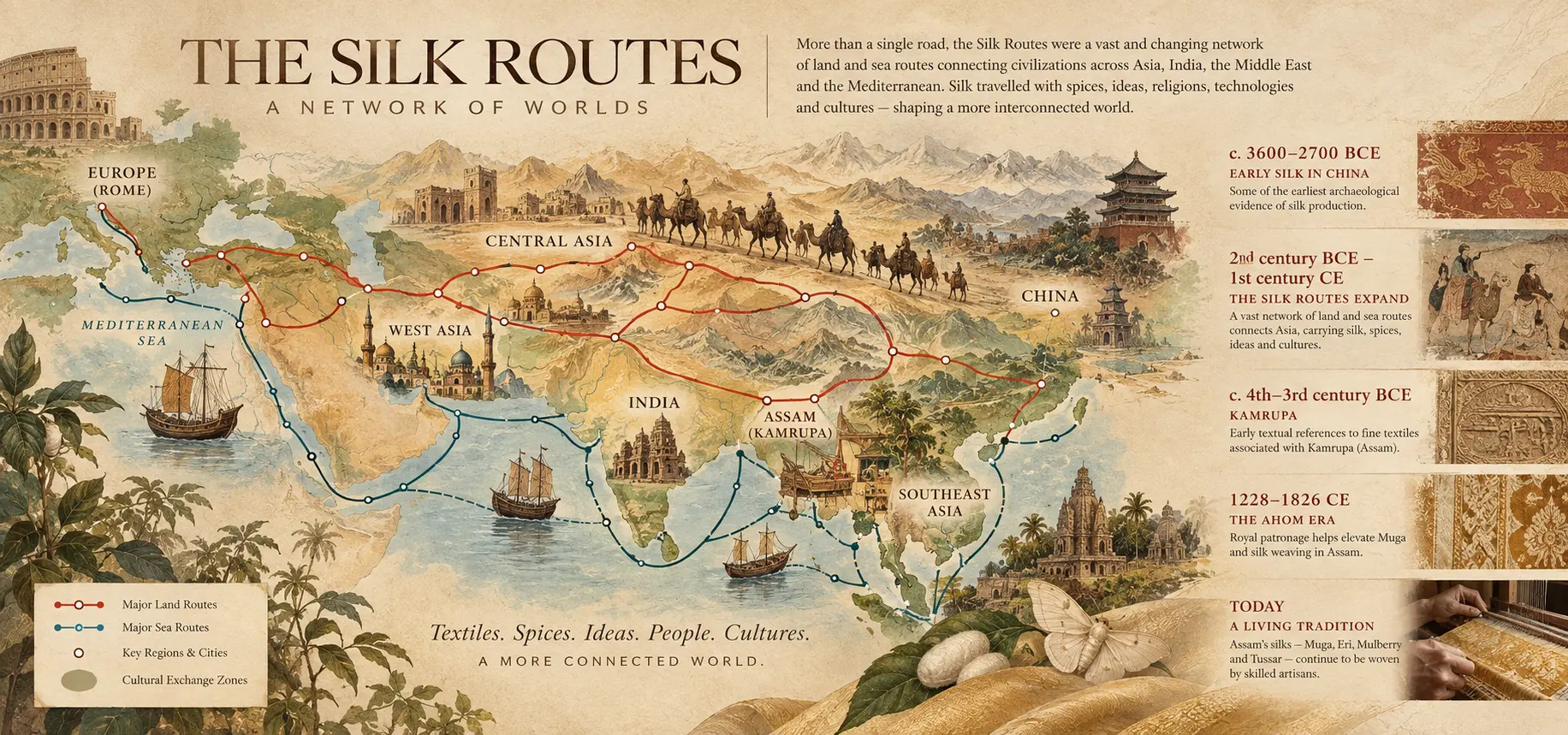
The Silk Road was never a single road running from China to Rome.
It was a vast and changing network of routes connecting societies across Asia, the Indian subcontinent, Central Asia, Western Asia and the Mediterranean world. Major corridors expanded significantly from around the 2nd century BCE into the 1st century CE, carrying luxury goods over extraordinary distances.
Silk was among the most prized of these goods.
But silk was never travelling alone. Along these routes moved spices, precious materials, textiles, technologies, artistic influences, religious traditions and ideas. Merchants, travellers and communities carried pieces of one culture into another, creating an interconnected world long before the modern idea of globalisation.
2nd century BCE – 1st century CE
Major Silk Road corridors took shape and expanded across Asia.
03 · 1877 CE
An Ancient Network, A Modern Name
The routes themselves are ancient. The name is not.
The term ‘Silk Road’ was coined in the 19th century by the German geographer Ferdinand von Richthofen. What we now describe as the Silk Roads were, in reality, a collection of interconnected routes that changed over centuries.
The name may have come later, but the exchange it describes had already been shaping Asia for generations.
The term ‘Silk Road’ enters modern historical vocabulary.
04
India Was Part of the Thread
Silk travelled through India too.
India was not separate from the wider world of Silk Road exchange.
The subcontinent was connected to the larger Asian trading world through multiple overland and maritime networks. Goods, people and ideas moved between India, Central Asia, Southeast Asia, West Asia and beyond.
Silk was one part of this exchange — but the larger story was one of movement: textiles, spices, knowledge, religion, artistic traditions and technologies travelling across borders and cultures.
The history of silk in India therefore belongs not only to the history of a fabric, but to the history of connection.
05
Kamrupa
A silk tradition with ancient roots.
Long before Assam became known to the modern world by its present name, the region of Kamrupa was already part of the cultural and political landscape of ancient India.
Historical sources contain early references to fine textiles associated with Kamrupa. Kautilya’s Arthashastra, generally dated to the 4th–3rd century BCE, contains descriptions of textiles associated with the region that later scholarship has connected with Assam’s silk traditions.
The exact origins of Muga silk production cannot be assigned to a single date. But these early references place the textile traditions of ancient Assam within a much deeper history than the modern idea of the Silk Road might suggest.
c. 4th–3rd century BCE
Early textual references associated with fine textiles from Kamrupa.
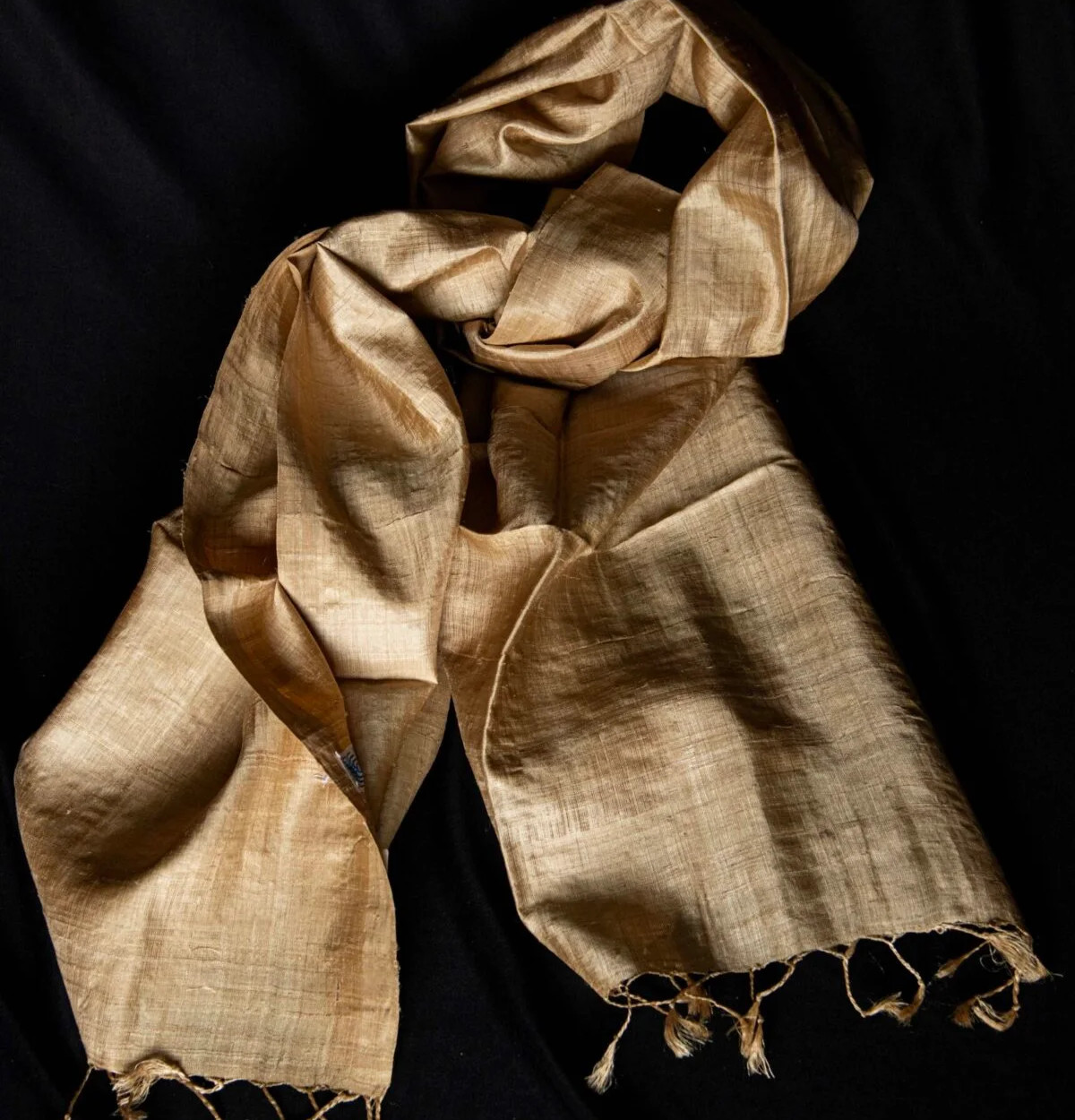
Muga · Antheraea assamensis · Assam
06
The Golden Thread of Assam
Muga became one of Assam’s most distinctive silk traditions.
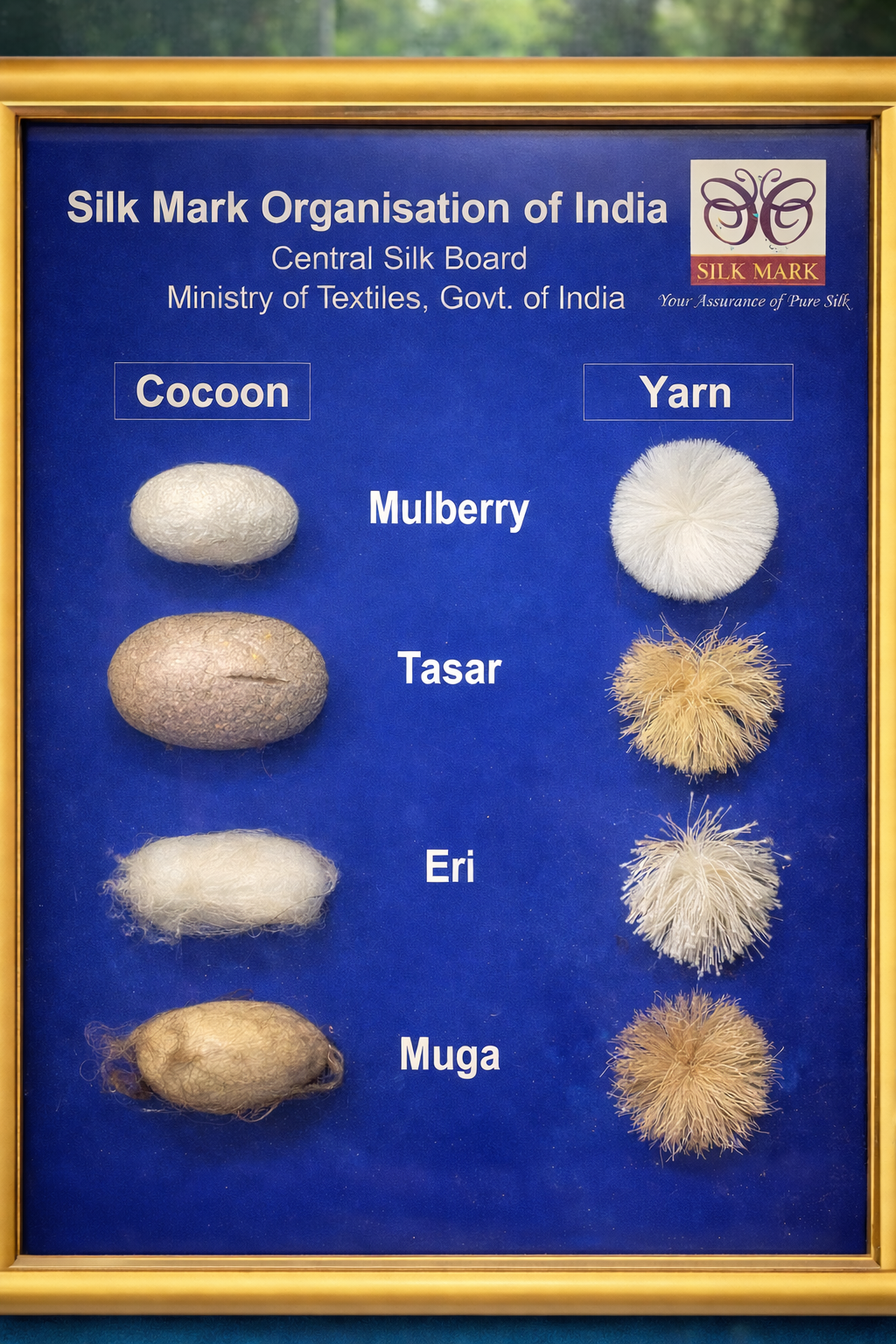
Assam is home to a remarkable silk heritage, including Muga, Eri, Mulberry and Tasar.
Among them, Muga holds a particularly distinctive place. Produced from the semi-domesticated silkworm Antheraea assamensis, Muga is indigenous to Assam and is known for its naturally golden character and distinctive lustre.
Its story is inseparable from the landscape, communities and generations of knowledge that surround it.
Assam’s sericulture tradition is described by the Government of Assam as having been practised from time immemorial, with Muga and Eri remaining especially important to the region.
07
Royal Threads
The Ahom era elevated Muga into a symbol of prestige.
From the 13th century, the Ahom dynasty became an important force in shaping Assam’s cultural and political life.
During the Ahom period, Muga received royal patronage and became closely associated with prestige, ceremonial dress and elite life. Silk weaving and sericulture developed as deeply embedded household and community practices, passing knowledge from one generation to the next.
The golden textile was no longer simply a material. It became part of the visual language of Assamese identity.
1228–1826 CE
The Ahom dynasty ruled Assam for nearly six centuries.
Royal patronage helped elevate Muga into a textile of status and ceremony.
08
The Living Loom
From royal courts to generations of weavers.
Silk in Assam was never only a courtly tradition.
It lived in homes, in communities and at the loom.
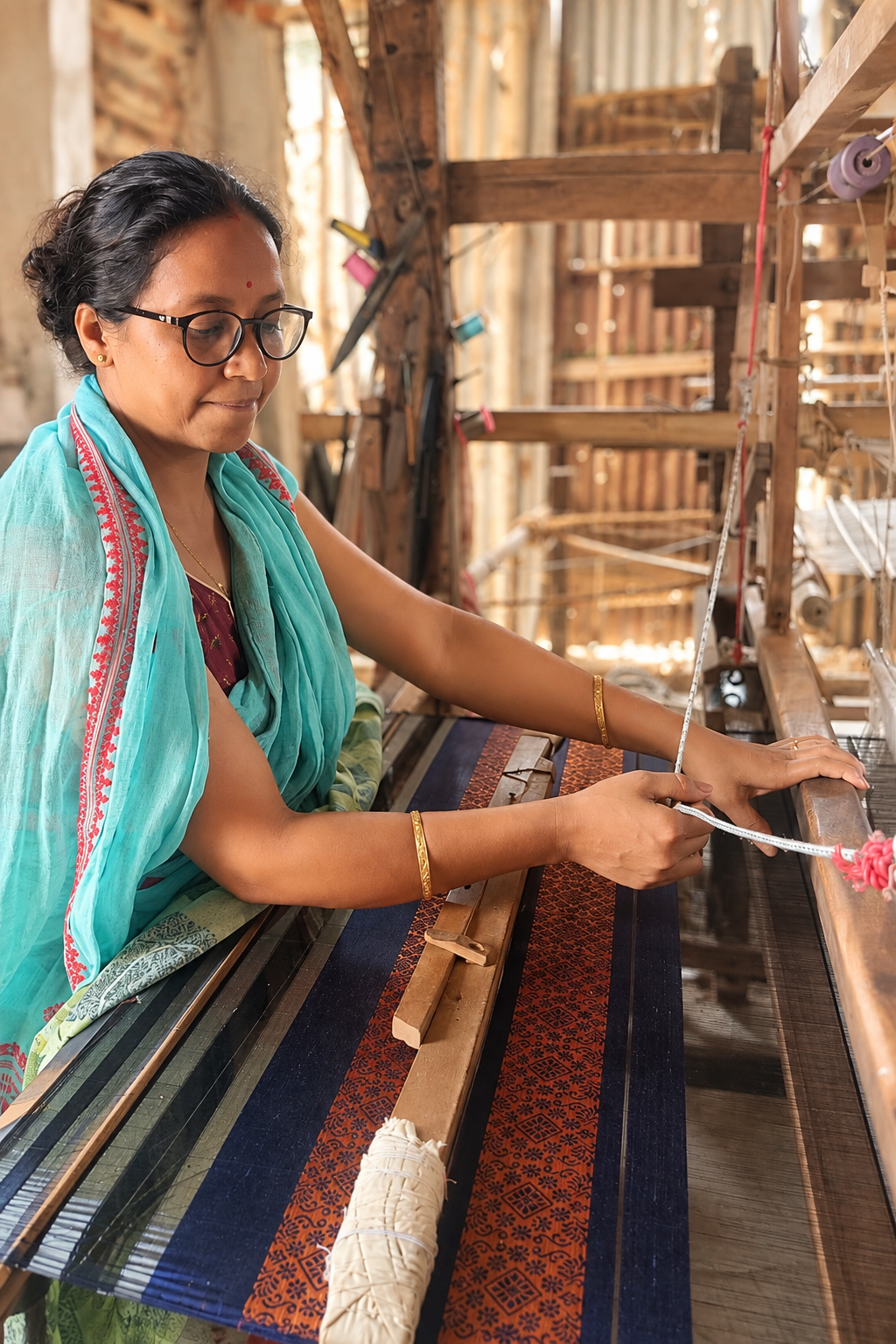
Rearing, reeling, spinning and weaving became skills carried through generations. The knowledge was not preserved in books alone; it was preserved through hands — through repetition, observation and the intimate understanding of fibre, thread, tension, colour and pattern.
This is what makes Assam’s silk heritage living rather than simply historical.

Sualkuchi · Assam
09
Sualkuchi
Where the thread becomes cloth.
On the banks of the Brahmaputra, Sualkuchi grew into one of Assam’s great silk-weaving centres.
Here, silk is not merely produced; it is transformed by hand — from yarn into fabric, from pattern into textile, from inherited knowledge into something that can be worn today.
The looms of Sualkuchi connect the present to generations of Assamese weaving tradition.
10
Not a Footnote. A Thread of Its Own.
The history of silk does not belong to one country, one route or one civilization.
China gave the world some of its earliest known silk traditions. The Silk Routes connected distant societies across Asia and beyond. India developed its own rich textile cultures. And within India, Assam cultivated silk traditions shaped by its own ecology, communities and history.
Assam followed its own distinctive thread through the wider Asian world.
Its silk traditions deserve to be understood not as a footnote to the history of silk, but as one of its many living chapters.
11
From Ancient Thread to Samrajni
Today, the thread continues.
At Samrajni, we work with the natural silks of Assam — Muga, Eri, Mulberry and Tussar — bringing an extraordinary textile inheritance into contemporary life.
We do not see heritage as something that belongs only in museums, archives or ceremonial wardrobes.
We see it in the fabric.
In the hands that weave it.
In the communities that preserve it.
And in the way it can be worn today.
The story that began centuries ago continues — not by remaining unchanged, but by being carried forward.
Ancient roots. Living craft. A contemporary expression.
The Thread Continues
From ancient traditions to contemporary silhouettes, the story of silk is still being written.
Explore the SilksHistorical Sources +
This history is written with care; dates are approximate where historians cannot establish exact origins.
- — UNESCO World Heritage Centre — Silk Roads: Routes Network of Chang’an–Tianshan Corridor.
- — World History Encyclopedia — Silk Road / Silk Road history.
- — Government of Assam, Directorate of Sericulture — Silk and its Production in Assam.
- — Government of India Handicrafts — Muga Silk.
- — Incredible India — Muga Silk and Assam.
- — NCERT — North East India: People, History and Culture.
The Soul of the Loom
Beauty lives in the details that cannot be replicated.
Handwoven silk is never perfectly identical. Small variations in weave, texture, colour, yarn and detailing are natural characteristics of authentic handcrafted textiles.
They are not imperfections to be corrected. They are evidence of the hand behind the work.
Every piece therefore carries its own character — a quiet reminder that it was made by people, not by a production line.
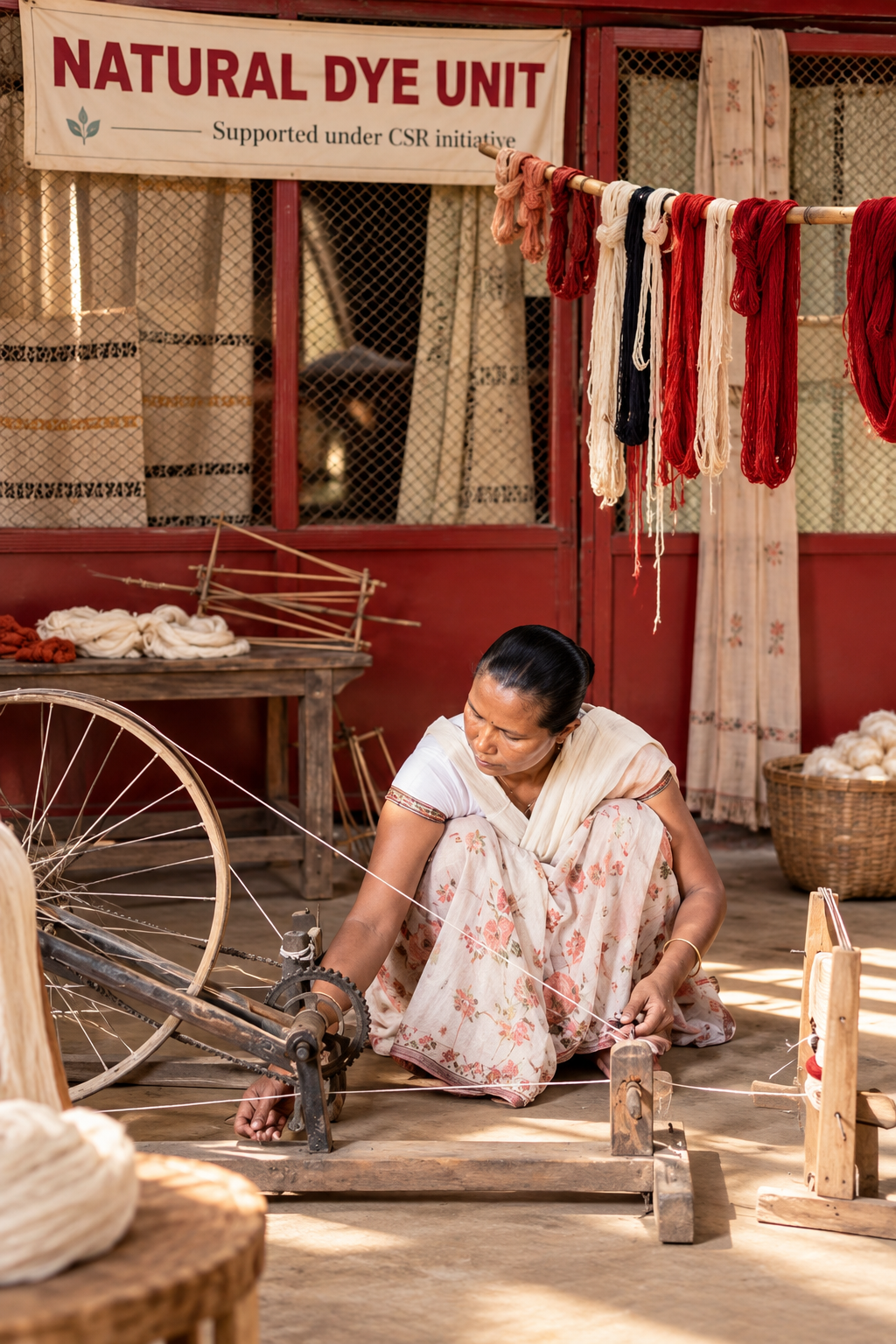
Meet Our Artisans
The Women Behind the Weave
The hands behind Samrajni carry knowledge that is learned slowly, lived daily and passed from one generation to the next.
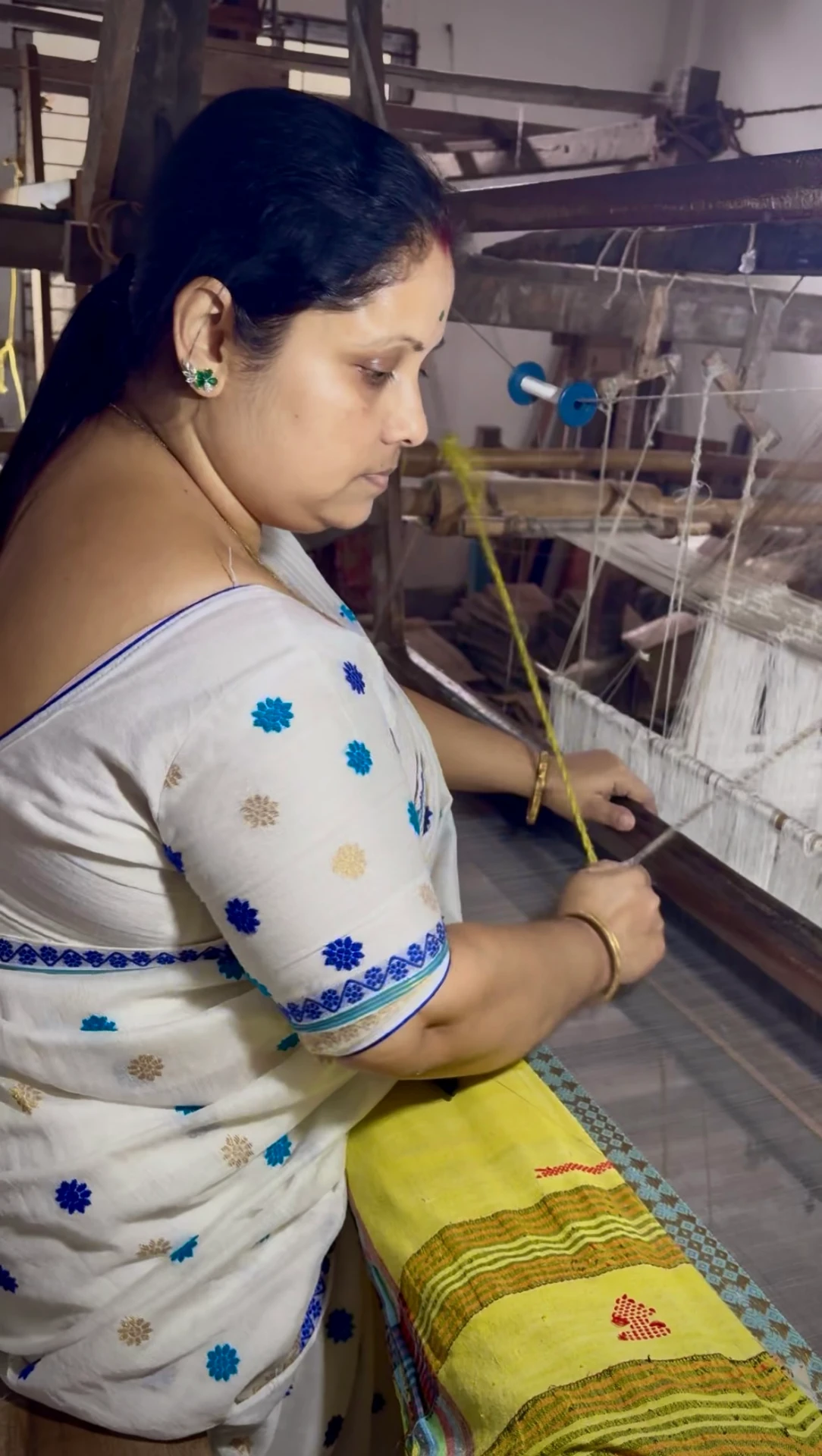
Weaver · Sualkuchi, Assam
Bhanita Das
For Bhanita, weaving began with curiosity and passion. She first learned to weave Mekhela Chadors for herself and her family, finding joy in creating something with her own hands. Over time, what began as a personal passion grew into her profession.
Weaving is also part of her family heritage. Her mother, an accomplished weaver herself, was one of the people who passed this knowledge on to her. Today, Bhanita brings that inherited knowledge and her own experience to every piece she creates.
What began as curiosity became a craft, and eventually, a part of who I am.
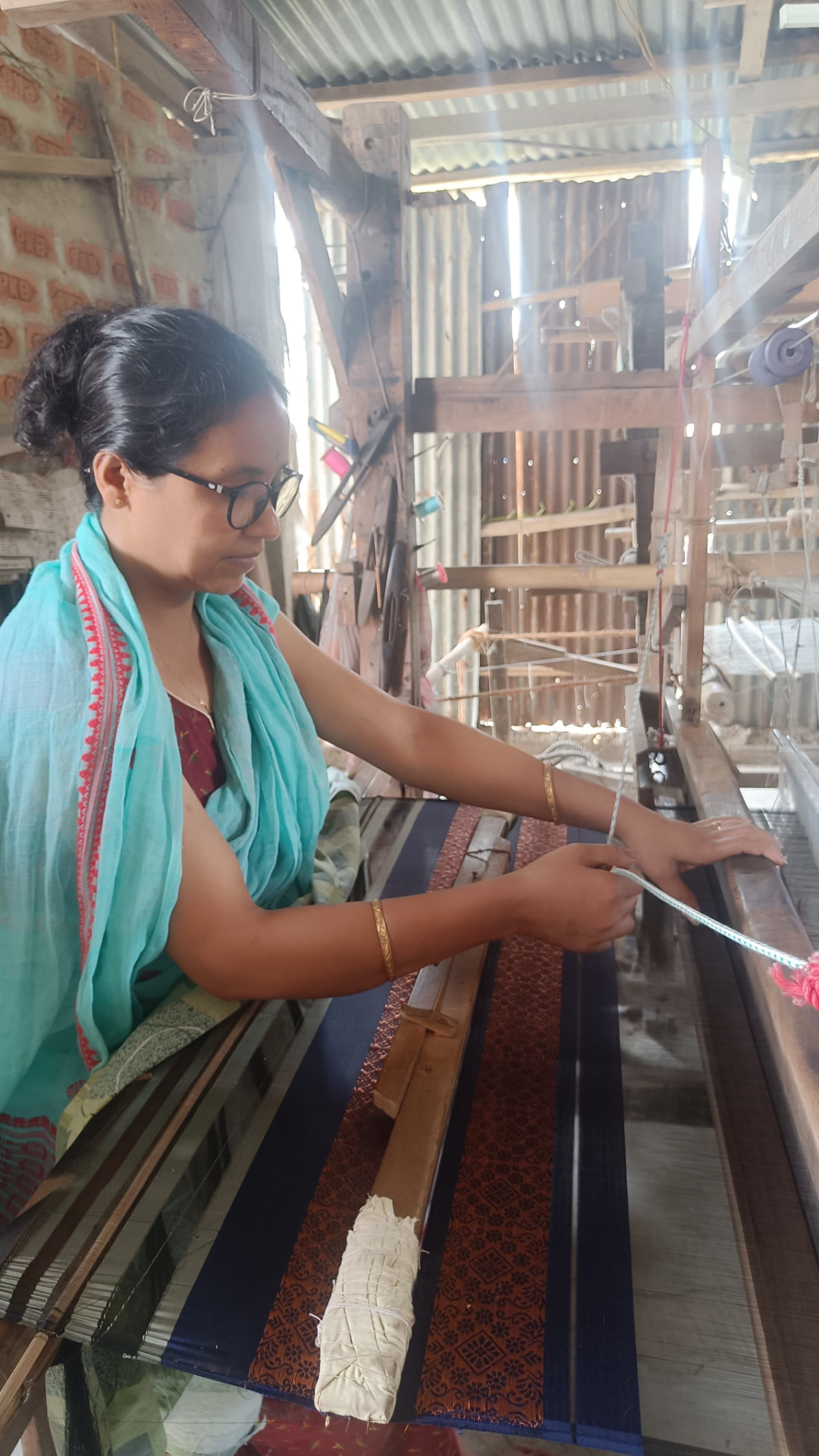
Weaver · Sualkuchi, Assam
Ranju Das
Ranju's journey into weaving began by helping others, including her husband, with their work. Over time, she learned the craft more deeply from her husband and other members of the family.
What began as a way to contribute to her family's livelihood gradually became a skill and profession of her own. Today, weaving is an important part of Ranju's life — connecting her family, her craft and the generations of knowledge that surround her.
I learned by helping my family. With time, weaving became my own craft.
Their hands are not behind the story.
They are part of the story.
Bhanita and Ranju are two of the many skilled hands who make our work possible. Beyond them is a wider community of weavers and artisan families whose knowledge, labour and livelihoods are sustained through the continuation of this craft. At Samrajni, we are grateful to play a small but meaningful part in that journey — creating opportunities for traditional skills to remain valued, and for the families behind them to continue to thrive. When you choose a Samrajni textile, you are not only choosing something made with care; you are also becoming part of a larger effort to keep this living craft and the livelihoods around it moving forward.
With gratitude to the artisans who bring every Samrajni textile to life.
The Samrajni Philosophy
We do not manufacture. We cultivate.
We do not mass-produce. We create with intention.
We do not chase trends. We make heirlooms.
At Samrajni, luxury begins long before a garment reaches the wardrobe.
It begins with the fibre, the loom, the artisan and the intention behind its creation.
We choose natural silk and handloom craftsmanship over the temporary language of fast fashion. Each piece is designed to be lived in, treasured and carried forward.
How Our Pieces Are Made
We do not believe in mass production.
Because our silks are natural, rare and deeply valued, we choose to work with intention rather than excess. We keep only a small selection of ready-to-ship pieces, while many of our garments are made-to-order.
This keeps our inventory considered, limits unnecessary production and gives each piece the attention it deserves.
- Ready to Ship
- An existing piece, available to order now and dispatched within the stated processing period.
- Made to Order
- Created after your order is placed. The approximate production timeline is shown on each piece.
- Bespoke / Commission
- Created specifically for you, including personalised measurements and design details where applicable.

Nature · The First Muse
The Empress is Nature.
Samrajni is an homage to the ultimate Empress — Mother Nature.
Our inspiration begins in Assam, where four remarkable silk traditions have evolved alongside the land and its people: Muga. Eri. Mulberry. Tussar.
Each silk carries its own character, texture and story. We bring these natural fibres into a contemporary world of refined silhouettes, creating clothing that respects the material rather than trying to disguise it.
The intention is simple: to let nature remain visible in what we wear.
The Source
From the Land of the Brahmaputra
Samrajni begins in Assam.
From the villages of Sualkuchi to the wider textile traditions of the region, the house is rooted in a living culture of silk, handloom and inherited craftsmanship.
Here, weaving is not simply a technique. It is knowledge passed from one generation to another — carried through hands, looms, patterns, fibres and time.
We bring that heritage into contemporary wardrobes without stripping away the character of where it began.
90% Woman · 100% Soul
The Weaver is the Empress.
In the villages of Assam, the hands behind our silk carry generations of knowledge.
A large part of the weaving community we work with is made up of women — master artisans whose skill, patience and inherited knowledge give life to the fabric.
At Samrajni, we do not see the artisan as a supplier. We see her as a collaborator.
Every thread, motif and woven detail carries her skill, her patience and a living inheritance of craft.
The garment may enter your wardrobe as luxury. Its story begins at the loom.
Our Four Silks
Our Four Silks. One Samrajni Spirit.
Muga
Golden. Strong. Distinctly Assamese.
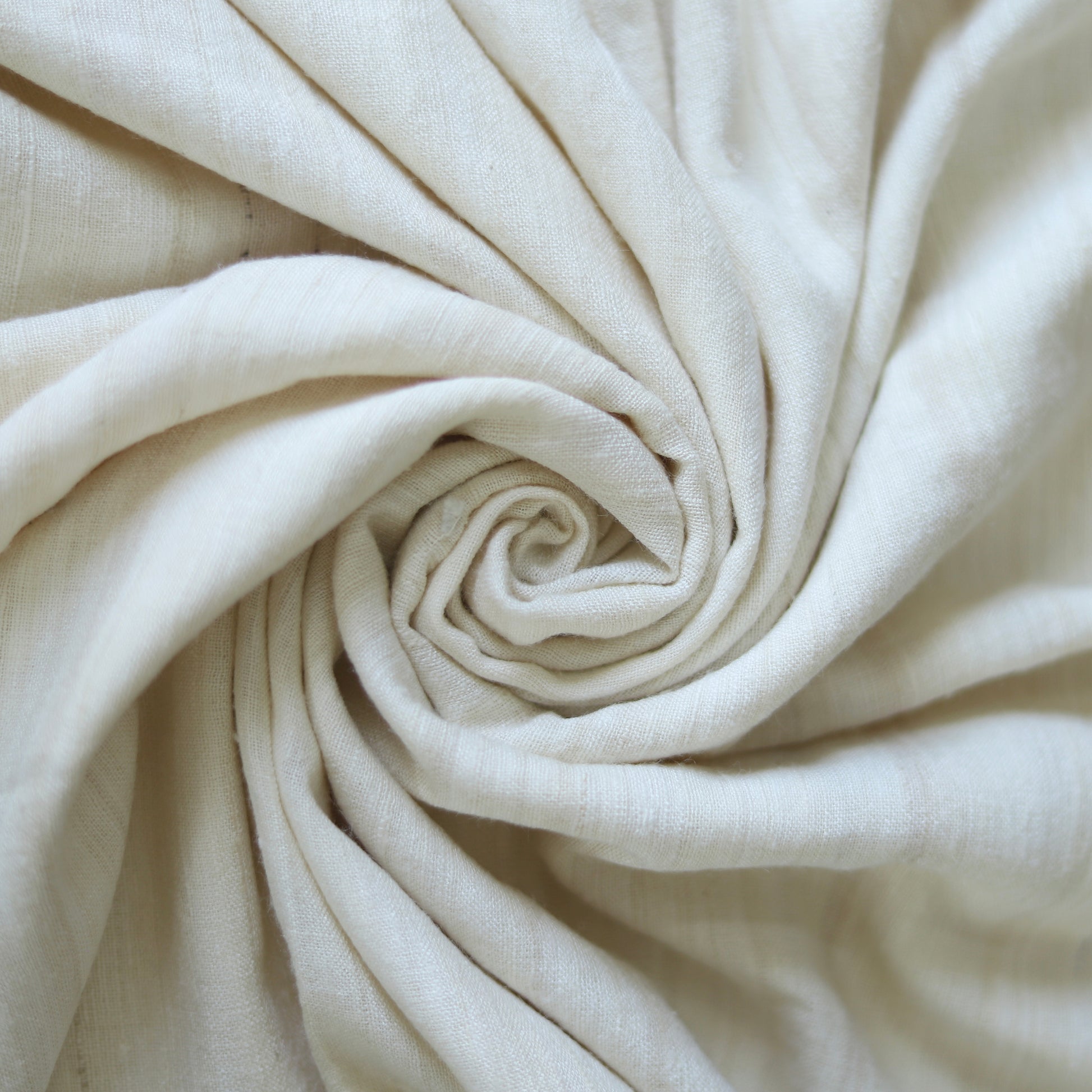
Eri
Soft. Matte. Textured. Naturally expressive.
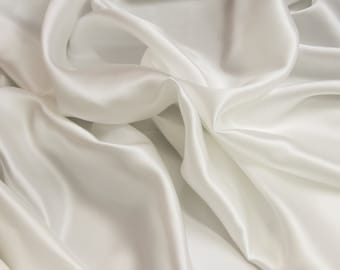
Mulberry / Paat
Pearly. Refined. Graceful.
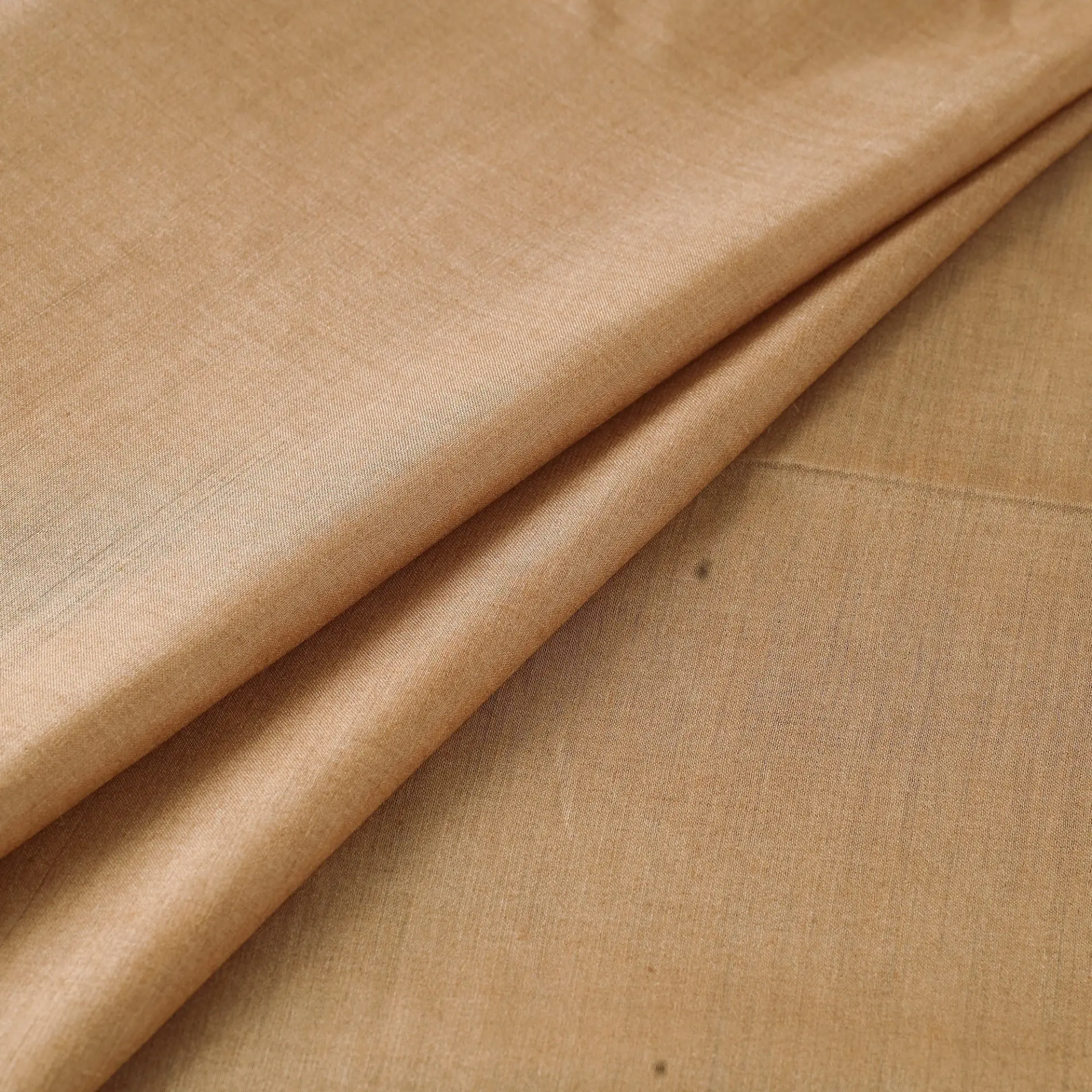
Tussar
Earthy. Organic. Naturally individual.
The Hands Behind the House
A Samrajni piece begins long before it becomes a garment.
It begins with the fibre. With the loom. With the artisan. With hours of patient work. Our relationship with the master artisans of Sualkuchi is central to the house. Their craft is not an additional detail attached to the garment. It is the foundation of it.
Design
Rooted in Heritage.
Designed for Now.
Samrajni does not recreate the past. We take the richness of Assam's textile traditions and translate it into contemporary clothing.
Natural silk becomes modern silhouettes. Traditional craftsmanship meets considered construction. Heritage becomes something that can be worn today — and remembered tomorrow.
The collections are designed for both women and men, moving between everyday refinement, contemporary dressing and significant occasions.
Enduring Design
Beyond the Trend.
Into the Forever.
We believe a garment should have a life beyond a season.
Natural silk, thoughtful construction and timeless design allow a piece to become more than something you wear once. It can become something you keep. Something you return to. Something that carries a memory. Something that may one day be passed on.
This is the idea behind Samrajni: not more clothes. Better ones.
Crafted with Intention
A piece created for a person.
At Samrajni, many pieces are created with intention rather than pulled from conventional inventory.
For made-to-order and bespoke creations, fabric, silhouette, measurements and finishing are considered with care before the garment begins its journey from the loom to you.
The Samrajni Promise
Natural Silk
We work with natural silk traditions rooted in Assam.
Handloom
We honour the skill and individuality of handwoven textiles.
Craft
We preserve traditional techniques while creating contemporary forms.
Intention
We create thoughtfully rather than chasing volume or trends.
Quiet Luxury.
Honest Roots.
Bespoke · Handloom · Natural Silk
Crafted in Sualkuchi, Assam.
Enter the Atelier